The Sweetness You Can’t Rush
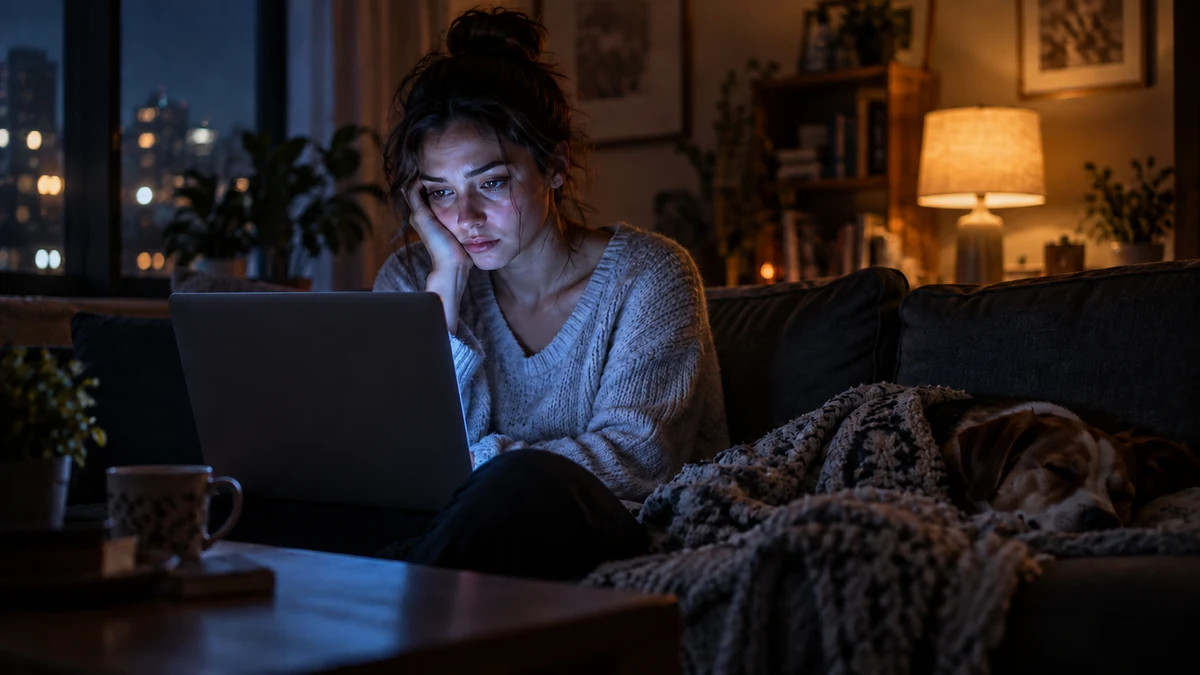
I was one click away from giving up.
The tab had been open so long the screen had dimmed twice. Personalized wedding favors. Overnight delivery. Bulk discount applied. A little cart icon in the corner, patient as a vulture. All I had to do was move my finger half an inch and the whole problem would vanish by Tuesday, gift-wrapped, guilt-free.
“You’ve been staring at that for twenty minutes,” Marcus said from the doorway. He had a dish towel over his shoulder and that careful look on his face, the one he wore when he could tell I was deciding something with my whole heart.
“I’m researching,” I said.
“You’re agonizing.”
I didn’t answer, because he was right, and because the cursor was hovering over Place Order and some quiet, tired part of me wanted him to just say do it, honey, click it, come to bed.
He didn’t. He came and sat on the arm of the couch and looked at the screen with me.
“It’s okay, you know,” he said gently. “Real brides buy things. Organized brides. People who have a job and a leaking gutter and a wedding in six weeks.”
“I know.”
“So?”
“So I can’t,” I said, and my voice cracked in a way that surprised us both.
Here’s the thing he already knew, the thing I needed to say anyway.
Our wedding was not the kind you could overnight ship.
We got engaged in my parents’ backyard, under the string lights my dad had been meaning to take down for three Christmases. Marcus was halfway through his speech, sweating, beautiful, completely losing the thread of it, when my mother flung open the kitchen screen door and yelled, “BROWNIES ARE OUT, who wants the corner piece. Oh. Oh. Am I interrupting? I’m interrupting. I’ll just,” and then she stood there anyway, oven mitt pressed to her heart, crying into the brownies.
That was us. That was the whole tone of the thing. A whitewashed barn with hay still in the corners. Wildflowers crammed into mismatched jam jars because we couldn’t afford a florist and didn’t really want one. A life held together with love and stubbornness and a little duct tape.
I wanted favors that tasted like that.
Not a keychain. Not a personalized bottle opener that would die in a junk drawer between expired mints and a hotel sewing kit. I wanted something a guest would actually hold, and use, and finish. Something edible. Something that said thank you for driving four hours and sitting on a hay bale for us without also screaming look how much money we spent.
So I chose honey.
Little two-ounce jars, wildflower seeds tied to each neck with twine. Sweetness and growth. Take this home and let something bloom. I said it out loud to Marcus the night I thought of it, and he kissed the top of my head and said, “That’s the one. That’s so you.”
Perfect.
In my head, it was perfect.
I started on a Saturday with a confidence that should have been illegal.
One hundred and twenty glass jars. Three gallons of honey from the farm stand off Route 9. Kraft labels. A spool of twine. A little wooden stamp that said SPREAD LOVE. And, because I wanted the kind of detail that makes people gasp, one hundred and twenty tiny wooden honey dippers, which had cost more than I would ever admit under oath.
Marcus carried the last box in from the car and set it on the dining table, which had disappeared entirely under my supplies.
“How much,” he said slowly, “did all of this cost?”
“Less than ordering them,” I said.
It was not less than ordering them. We both let the lie sit there on the table, polite as a centerpiece.
I built an assembly line like I was running a factory that had won awards. Jars in rows. Labels stacked and squared. Twine pre-cut into a hundred and twenty identical lengths. I put on a playlist literally titled Cozy Wedding Vibes and told myself, out loud, “This is going to be fun.”
It was fun for twelve jars.
Then the honey got involved.
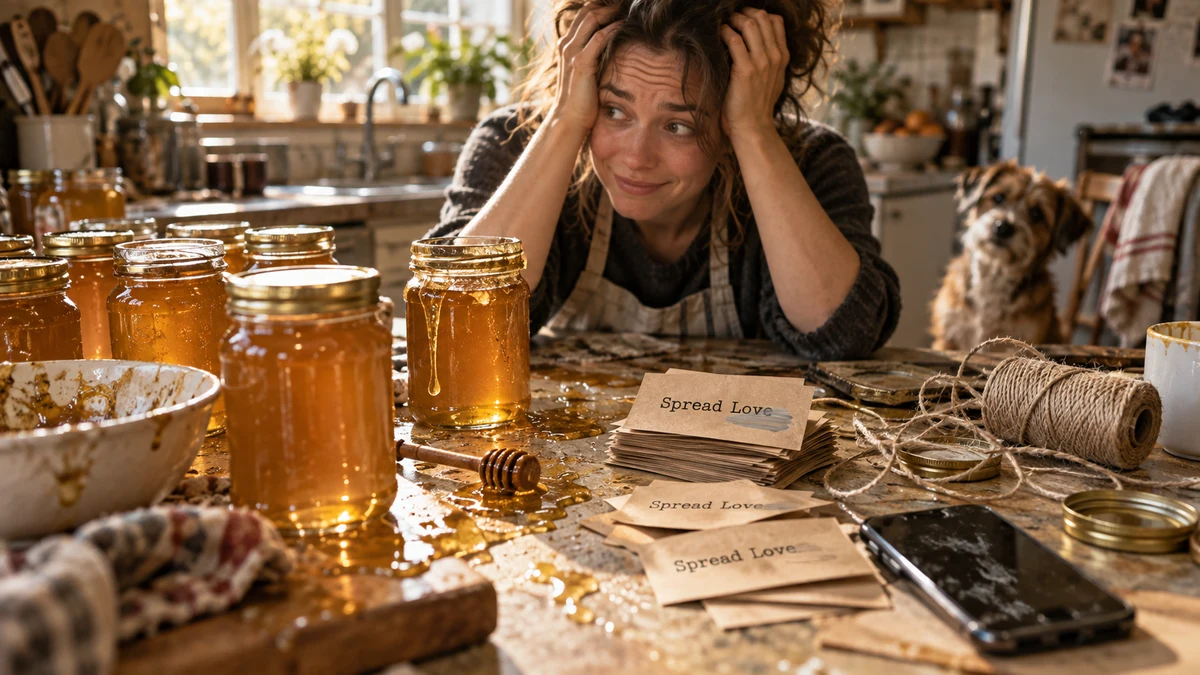
Nobody warns you that honey has personality.
Water obeys. Water goes where you point it and stops when you stop pouring. Honey does not. Honey moves on its own schedule, slow and golden and relentless, sticky beyond all reason and decency. It clings. It strings. It finds seams in the universe you didn’t know existed and travels into them like it has somewhere to be. One drip becomes a ribbon. One ribbon becomes a puddle. One puddle becomes the counter, then my sleeve, then my phone, then, I am not exaggerating, the dog.
“Why is Biscuit shiny?” Marcus asked, passing through.
“Don’t touch him.”
By jar twenty-three, there was honey on surfaces I hadn’t gone near. On the bottoms of jars I would have sworn under oath I had never touched. My hands felt like they belonged to someone else. A strand of my hair had glued itself to my cheek and was now, somehow, also participating.
“You can’t rush sweetness,” I said to the empty kitchen, like a woman in a movie about a woman losing it.
And then I tried to rush it anyway.
I tried a funnel. The funnel clogged. I tried a squeeze bottle, and the squeeze bottle produced one heroic blast and then nothing. I warmed the honey in the microwave so it would flow, and it flowed, gloriously, everywhere, all at once. I cooled it back down. I put everything on a cookie sheet, as though a cookie sheet were a moral boundary the honey would respect. I tried breathing the way the app tells you to breathe. In for four. Hold. Out for…
A drip landed on my bare foot.
And that was just the filling.
The labels were supposed to be the easy part. Print, peel, stick. Done.
Except the printer, sensing weakness, developed feelings.
The first sheet came out with the text nudged a half-inch off-center, like a smirk. The second had a gray streak dragged straight through the word Love. The third jammed, made a noise like a small animal, and ate half a cartridge of ink before I could save it.
I stood there.
I looked at the printer. At the dining table, glistening and ruined. At the crooked, sticky, imperfect jars, fewer than thirty of them after four hours, and that old familiar tightness climbed up into my chest. The one that has a voice. The one that says, very quietly and very reasonably: You are not the kind of woman who can pull this off. You never were. You just hoped really hard, and hope ran out.
Marcus found me crying over a jammed printer at 6 p.m.
He didn’t say it’s just favors. I will love him forever for not saying it’s just favors. He crouched down so his eyes were level with mine and said, “Okay. What do you actually need? Not what would fix the wedding. What do you need, right now, tonight.”
And the answer came out of me before I could be embarrassed by it.
“I need help,” I said. “I need actual help. Hands. People.”
“Then text people,” he said. “That’s okay too.”
So I did the thing I hadn’t done once in six months of wedding planning.
I asked. Out loud. For real.
Not the vague let me know if you ever need anything! that everyone offers and nobody means. I texted my mom: Kitchen emergency. Honey everywhere. Bring nothing, just come. I texted Priya, my maid of honor: I’m drowning. Literally. It’s sticky. Please. And then, hand actually shaking a little, I texted Marcus’s mother, Carol, a woman I had spent a year being slightly afraid of, certain she was quietly judging me.
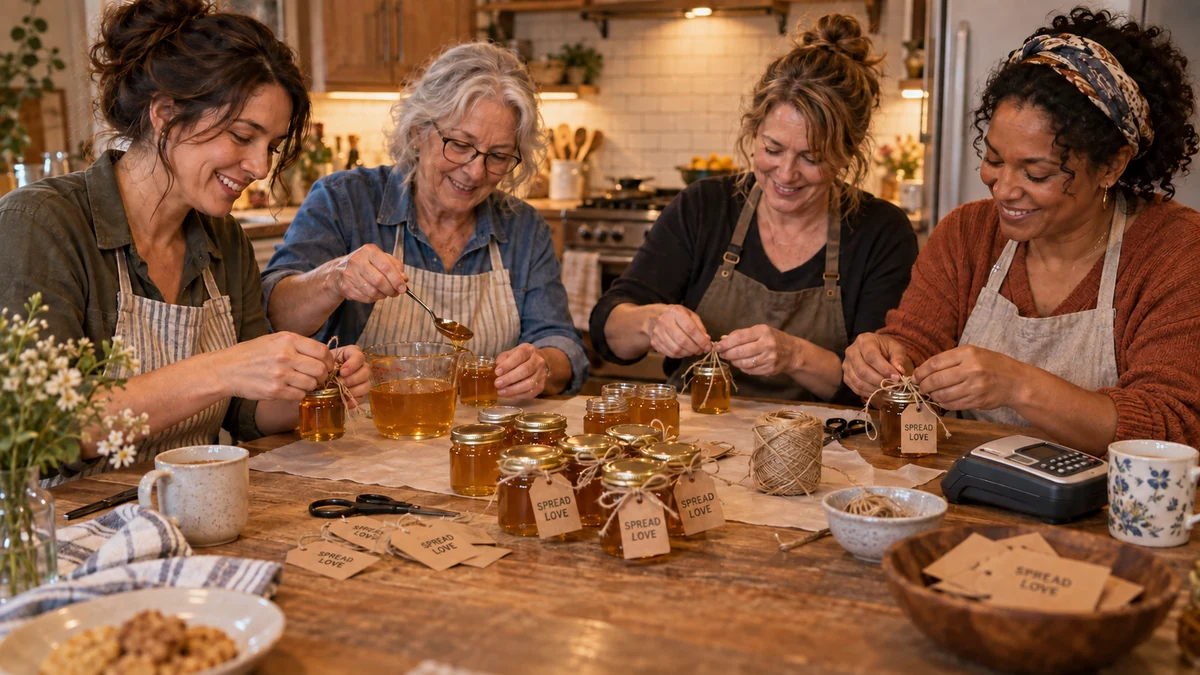
Within the hour, my kitchen was full of women holding coffee and opinions.
My mom took one look at the disaster and put her purse down like a sheriff laying down the law.
“Oh, honey,” she said. “You’re doing this backwards.“
“It’s an assembly line, Mom.”
“It’s a crime scene.” She was already moving. She tore off a sheet of parchment, lined a tray with it, and started building actual stations. Fill here, wipe here, label here, tie there. “You don’t fill then clean. You clean as you go, or the sticky wins. The sticky always wins.”
Priya picked up one of my pre-cut lengths of twine, held it up, and squinted at me with open concern.
“Babe. Why is this twine so short? Were you trying to strangle the jars?”
“I measured…”
“You measured like you hate yourself,” she said, and started re-cutting the whole spool, longer, kinder.
And Carol, the one I had braced myself for, set a label maker on the counter with a soft clack, rolled up the sleeves of her good blouse, and looked at me with something I had completely failed to predict on her face. Warmth.
“Right,” she said. “Let’s make these gorgeous, shall we?”
I think I cried again. But it was a different kind. The kind that doesn’t have a voice in it.
The whole project changed in the space of an hour.
It stopped being a performance, me alone, auditioning for the role of Good Bride in front of an empty theater. It became something messier and better. A ritual. Four women in a too-small kitchen, sleeves up, figuring it out together.
We warmed the honey just slightly, just enough, and ladled it with a wide-mouth funnel like adults who had nothing to prove. We wiped down every single jar with a warm damp cloth before labeling, a step that would never have occurred to me, because I had still been living in the fantasy version of this night where things simply went well.
When the printer labels came out crooked again, Carol didn’t even look up. “Stamp them by hand,” she said. “Kraft tags. If a thing’s not perfectly straight, you call it rustic, and now it’s charming. That’s the whole secret. That’s marriage, honestly.”
Priya snorted. My mom said, “She’s not wrong.”
We tied the seed packets with the longer twine, not too tight, because tight twine cuts the paper, and the paper rips, and ripping paper makes brides cry, and we had agreed there would be no more of that tonight.
The hundred and twenty tiny wooden honey dippers turned out to be too long to tie onto the jars. There was a beat where I felt the panic try to come back. Then my mom just said, “So they go in a basket,” and put them in a basket, and the panic, deprived of oxygen, went away.
Marcus came in around jar sixty, leaned in the doorway with Biscuit (de-honeyed) at his feet, and watched the four of us for a long moment.
“This is kind of amazing,” he said quietly.
I didn’t answer right away. My hands were still sticky. So, I noticed, was my heart, but in the good way now. The way that means a thing got into you and isn’t leaving.
Somewhere between jar sixty and jar ninety, I figured out what the night had actually been about.
It was never the honey. It was never the seeds, or the dippers, or the money, or the badge I’d been trying to earn, that invisible certificate that says GOOD BRIDE, GOOD WOMAN, HAD IT TOGETHER.
It was resistance.
Not the loud, angry kind. The quiet kind. The kind that says: our wedding doesn’t have to look like an advertisement. The kind that says: we can make a thing with our own hands, and it can still be beautiful, and the unevenness is not a flaw, it’s a fingerprint. The kind that says: people won’t remember whether the labels were straight. They will remember how the day felt.
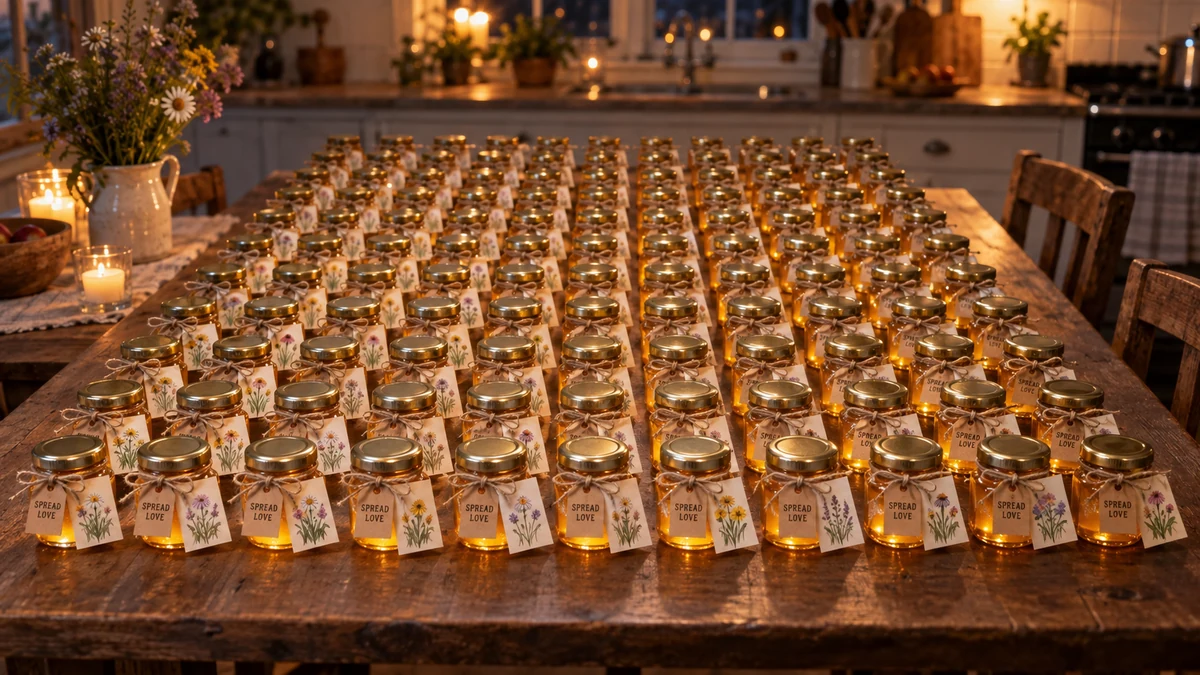
The last jar was filled at 9:42 p.m.
My mom photographed it like she’d planted a flag on a mountain. Priya raised a honey dipper like a champagne flute and announced, “To the bride, who is bad at measuring twine and great at everything else.” And Carol, my mother-in-law, my family now, I understood that fully for the first time that night, pulled me into a hug and said, into my hair, “You did this. Look. You did this.”
I looked at the table. One hundred and twenty little jars, lined up in the kitchen light like tiny, sunlit promises.
And I felt a calm I hadn’t felt all year.
Not because everything was perfect. Because I had finally, completely, made my peace with imperfect.
The wedding morning arrived like a wave you don’t get to brace for.
Hair. Makeup. A timeline nobody was following. Someone had lost a boutonniere. Someone had already spilled champagne on something white. The florist called, apologetic, about a delayed arrangement.
And I wasn’t spiraling.
Because once you’ve wrestled honey into one hundred and twenty jars, the universe simply has less power over you. I had looked chaos directly in the face. We were old acquaintances now.
We set the favors on a long wooden table near the barn’s exit. Mason jars catching the late light. Hand-stamped kraft tags. Twine bows, none of them identical. Seed packets like small folded hopes. A little sign Priya had lettered: Take a little sweetness home.
Guests didn’t just grab them on the way out.
They stopped. They read the tags. They laughed at SPREAD LOVE. They dipped a finger in and tasted it right there, not even pretending to be polite about it.
My aunt Diane held one up to the candlelight and said, “Sweetheart, this is the first wedding favor in my entire life that I actually want.“
A college friend turned a jar over in her hand and said, simply, “This is so you. This is the most you thing I’ve ever seen.”
And then a kid, maybe seven, in a tiny clip-on tie, came barreling up to the table, grabbed two jars, and looked up at his mother with enormous, serious eyes.
“Can I have one for Grandma?” he whispered. “She likes honey. She’ll really like this one.”
His mom met my eyes over his head and nodded, and she had the expression of a person who has just been handed proof that the world still keeps a little softness in it.

The best part happened during a slow song.
Marcus, my husband, a word still so new in my mouth it felt borrowed, leaned in close, his cheek against my temple, and said, “You were right.”
“About what?”
“About making it ours. About all of it. The jars. The barn. The honey on the dog.” He pulled back enough to look at me. “I almost let you click that button. I’m really glad you didn’t.”
I looked out at the barn. The wildflowers in their mismatched jars. The candlelight. My mom dancing badly and joyfully with my dad. Carol laughing at something. Priya already eating a favor. Every person we loved, gathered into one warm, imperfect, living, temporary thing we had built with our hands for the length of a single day.
And I thought about the jars again. Honey and seeds. Sweetness and growth.
Love is not a product you order and have delivered by Tuesday. It is something you make. Slowly. Patiently. With sticky hands, and a jammed printer, and your mother-in-law’s label maker, and people who actually show up when you finally, finally ask them to.
When the night ended, only a handful of favors were left on the table.
Because they were never decoration. They had been eaten. Pocketed. Carried home. Saved for grandmothers.
And as we drove away, exhausted, glowing, Marcus’s hand warm over mine on the gearshift, I understood that the real gift was never the thing the guests carried out in a jar.
It was the thing I was carrying forward.
If you can survive the mess, you get to keep the meaning.
The sweetness you can’t rush always tastes better. And it sticks, not to your hands in the end, but to your heart, in a way that perfect never, ever could.
Sweetness You Can Make
Love is something you make slowly, with sticky hands and people who show up. If homemade favors feel like your story, our DIY guide helps you pick ones you can actually make, without the honey on the dog.